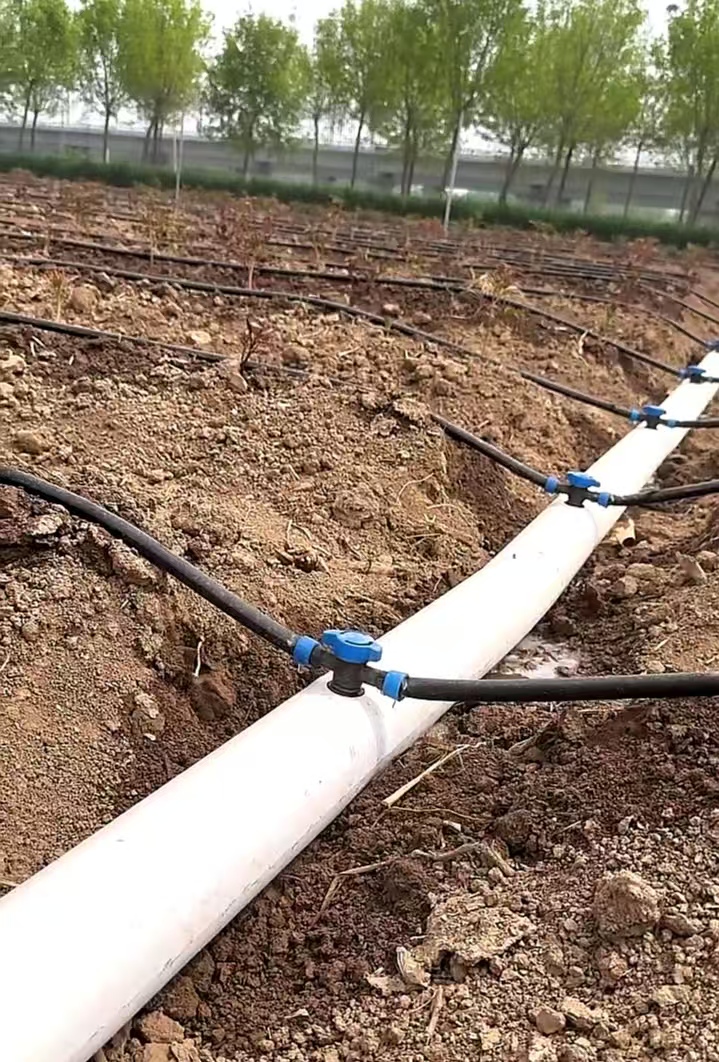
Short answer: Use 1/2″ tubing as the mainline for almost every home drip system — it carries roughly 120–240 GPH, enough for hundreds of emitters. Step up to 3/4″ only for runs longer than about 200 feet or a zone drawing more than ~200 GPH. Use 1/4″ micro tubing only for short branches from the mainline to individual plants; it maxes out around 30 GPH and 50 feet. Match the tubing to your total flow, not your plant count, or you’ll lose pressure at the far end.
By the ProIrrigate Team · Updated October 2026
The three sizes, in plain terms
- 1/4″ (micro tubing): thin branch line that runs from the mainline to a single plant or a small cluster. Flexible, cheap, easy to stake.
- 1/2″ (mainline): the workhorse. Carries water from the head assembly out to the beds and feeds the 1/4″ branches.
- 3/4″ (large mainline): for big zones, long runs, or when a single line feeds several beds.
They’re not interchangeable. The mistake most beginners make is treating 1/4″ as a mini mainline — it chokes flow the moment you hang more than a handful of emitters on it.
Comparison table
| Size | Typical OD | Main job | Max flow (approx.) | Max run length | Use it for |
|---|---|---|---|---|---|
| 1/4″ | ~0.25 in | Branch to individual plants | ~30 GPH (0.5 GPM) | ~50 ft | One plant, a short row of 2–3 |
| 1/2″ | ~0.60 in | Home mainline | ~120–240 GPH (2–4 GPM) | ~200 ft | The backbone of almost any garden system |
| 3/4″ | ~0.80 in | Large mainline | ~300–480 GPH (5–8 GPM) | 200+ ft | Long runs, multiple beds, high total flow |
These are planning figures — real capacity drops with wall thickness, fittings and elevation. The published numbers above reflect common polyethylene drip tubing specifications.
How to pick the right size
Two inputs decide it: total emitter flow in the zone and how far the water has to travel.
- Add up every emitter’s GPH in the zone (e.g., 40 emitters × 1 GPH = 40 GPH).
- Compare against the table. 40 GPH is trivially within 1/2″ capacity, so 1/2″ mainline is correct.
- Check the run length. If that 40 GPH has to travel 250 feet, 1/2″ starts to lose pressure at the far end — move to 3/4″, or split into two shorter zones.
The constraint is almost never the faucet. It’s the tubing’s ability to move water without losing pressure over distance (friction loss). Long, thin lines starve the last emitters — exactly the symptom covered in our low-pressure troubleshooting guide.
The standard home layout
For the vast majority of vegetable gardens and shrub beds:
- 1/2″ mainline runs along the bed edge or path.
- 1/4″ micro tubing branches off at each plant, staked to the root zone.
- Emitters sit at the end of the 1/4″ runs, or are punched directly into the 1/2″ line for rows.
This keeps the high-capacity line doing the hauling and the thin line doing only short, local delivery — where its 30 GPH limit is never a problem.
Wall thickness (a quick note)
1/2″ tubing comes in different wall thicknesses, often called 0.600″ and 0.700″ (the inside diameter stays similar; the wall gets thicker). Thicker wall (0.700″) resists kinking and UV better and holds up to higher pressure, at a small cost premium. For a permanent in-ground or sunny installation, the thicker wall is worth it.
Five tubing mistakes
- Using 1/4″ as a mainline. Hang more than a few emitters on it and the far end barely drips.
- 1/2″ too small for a long run. Over ~200 ft, step up to 3/4″ or split the zone.
- Mixing sizes without thinking about flow. A 1/2″ line fed by a 1/4″ branch is a bottleneck waiting to happen.
- Buying by plant count, not flow. Ten 2 GPH trees (20 GPH) and two hundred 0.5 GPH herbs (100 GPH) need very different mainlines.
- Ignoring the head assembly. Tubing size means nothing if the filter or regulator is undersized — sizing the head is covered in our installation guide.
FAQ
Can I use 1/4″ tubing for my whole small garden? Only if the whole garden is within ~50 feet of the source and draws under ~30 GPH. Past that, pressure drops and emitters starve.
How many emitters can 1/2″ tubing handle? Capacity is about 120–240 GPH, so roughly 120–240 emitters at 1 GPH — far more than most home gardens need. Run length, not count, is usually the real limit.
Do I need 3/4″ tubing? Only for long runs (200+ ft) or zones above ~200 GPH. If you’re unsure, 1/2″ is right until your layout says otherwise.
Does tubing size affect my flow-rate math? It sets the ceiling. Your emitter GPH math (see our flow-rate guide) tells you the demand; this article tells you whether the pipe can deliver it.
Sources and method: Flow and run-length figures reflect common polyethylene drip tubing specifications from major manufacturers. All values are planning estimates — confirm against your actual layout, fittings and local conditions.
Related: How to Install a Drip Irrigation System · Drip Emitter Flow Rates Explained · Drip Irrigation Troubleshooting